Founder's Journal
Paper Rex Didn't Wait for Permission — Neither Should India. The Train is Leaving.
Paper Rex didn't wait for the world to believe in Southeast Asia. India is still waiting for someone to believe in us.
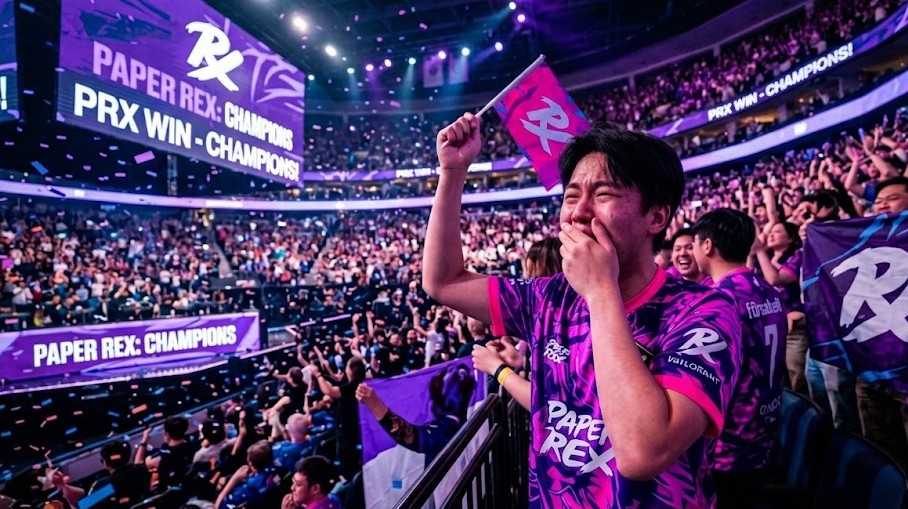
There is a moment in eSports history that Indians should have felt more personally than they did.
May 2025. Valorant Masters Toronto grand finals. An intense battle with Fnatic and the team walking out as champions — the first Southeast Asian FPS team to ever win an international trophy — was not from Korea. Not from Europe. Not from North America. It was Paper Rex. A team from Singapore, built with players across Southeast Asia, competing in a region the global esports establishment had written off as a talent development backwater for most of the game's existence.
In 2025, Paper Rex made history by becoming the first South-East Asian FPS team to win an international trophy at VALORANT Masters Toronto.
India watched. India cheered. India posted about it on social media and called it inspiration. But most importantly, we forgot to believe.
India went back to doing exactly what it was doing before — producing individual talent in isolation, with no structure, no pipeline, and no institutional belief that the same thing could happen here.
This piece is about why that's a mistake. And about what PRX actually did that India hasn't yet understood.
Who Paper Rex Is — And Where They Came From
Paper Rex started back in January 2020, founded by previous Counter-Strike legend Harley "dsn" Örwall and Southeast Asian esports personality Nikhil "nikH" Hathiramani. After seeing Valorant from Riot Games, PRX jumped into the competitive arena and signed a Singaporean team in July 2020. The team had a rough time initially with the roster and multiple changes — but the organization showed resilience and vision, shifting their CS:GO roster into Valorant in early 2021 and bringing in experienced players like f0rsakeN and d4v41, which is where it started to take off.
They won Stage 1 in 2024 and Stage 2 in 2025 — winning the Pacific League every year until 2025 — and recently won Stage 1 in 2026, claiming the most Pacific titles of any team and establishing themselves as the representative powerhouse of the region.
Throughout the 2025 season, PRX consistently remained among the best-performing teams in the world — with their combination of composure, adaptability, and firepower making 2025 arguably the most successful year in the team's history. So how did this team go from being one of the most rogue teams to cultivating five S-tier players in its roster?
This did not happen by accident. And it did not happen because Southeast Asian players are genetically gifted at Valorant. It happened because of a set of deliberate decisions — about identity, about culture, about what kind of team they wanted to be — that most esports organizations in Asia, including India, have not made.
What PRX Actually Did Differently
They built an identity before they built a roster
Most esports organizations in Asia follow the same playbook: find the best available individual players, sign them, and hope the chemistry emerges. Paper Rex did the opposite. They built an identity first — an aggressive, chaotic, mechanically expressive style of play that became known as "W-Gaming" — and then built a roster around players who embodied that identity.
PRX's intuitive, mechanically dominant "W-Gaming" style was cultivated under their coach alecks — a philosophy built around raw individual brilliance and chaos rather than the structured, systematic approach favored by international organizations.
This matters more than it sounds. Identity-first team building creates a culture that outlasts any individual player. When PRX lost players to roster changes, the identity survived. The style survived. The fanbase survived. Because what people were attached to wasn't a lineup — it was a way of playing.
India's esports organizations have not done this. They have signed individual talent and called it a team. PRX built a team and let talent flow through it.
They stayed together
With d4v41 and something re-signing, Paper Rex retains the chemistry that has defined its identity since 2021. Alongside f0rsakeN and Jinggg, the team continues to represent Southeast Asia at the highest level. "The team has not only grown closer together but also grown up together — we're really proud of that," said Harley "dsn" Örwall, Chief Gaming Officer of Paper Rex.
Grown up together. That phrase is doing more work than it appears to.
The single biggest structural problem in Indian esports is roster instability. Players get signed, underperform for one split, get dropped, and cycle through organizations in a pattern that prevents any genuine team chemistry from developing. PRX's core has played together across multiple seasons — learning each other's tendencies, building communication shorthand, developing the kind of trust that allows a player to make an aggressive call knowing their teammates will follow without hesitation.
You cannot buy that with a signing. You build it through time. PRX gave their players time. Indian organizations almost never do.
They developed players, not just competed with them
When Jinggg had to take a break for National Service and later dealt with a lifelong medical condition, Paper Rex held his contract, kept him as a reserve player, and eventually reintegrated him into the roster. That is not what a purely transactional organization does. That is what an organization that genuinely invests in its players does.
This development mindset — treating players as long-term assets rather than short-term performance inputs — is what creates generational teams. PRX didn't just compete. They developed. The players who joined PRX in 2021 are better players in 2026 not just because they've played more games, but because they've been in an environment that actively made them better.
They made Southeast Asia believe
Perhaps the most underrated thing PRX did is cultural rather than competitive. Before PRX, the implicit assumption in global Valorant was that Southeast Asia was a region that produced interesting players and entertaining play but could not win at the highest level. The ceiling was acknowledged, quietly, by almost everyone — including players from the region itself.
PRX broke that assumption. Not just by winning — but by how they won. Aggressively. Expressively. In a style that was unmistakably theirs, unmistakably Southeast Asian, refusing to imitate the structured methodologies of Korean or European teams and instead trusting that their own approach to the game was legitimate at the highest level.
That matters for every young player in Southeast Asia who watched Masters Toronto and recalibrated what they believed was possible. It matters for coaches who now know the methodology they've been building is viable. It matters for organizations who now understand that investing deeply in regional talent development is not a consolation prize for failing to import established players.
It matters for India too — if India is paying attention.
What India Has That PRX Started With
Here is the uncomfortable truth about the PRX story in an Indian context: the raw material India has is at least as good as what PRX started with — and in some respects better.
India has a gaming population of over 500 million. India has players who have reached Immortal and Radiant ranks in Valorant on hardware and internet connections that would make most European players quit. India has a youth demographic that is more gaming-native than any equivalent cohort in Singapore or Malaysia. India has the hunger — the specific, acute hunger that comes from having nothing handed to you and everything to prove.
What India does not have is what PRX had around its players: an organization with a clear identity, a patient development philosophy, stable roster management, and the institutional belief that Southeast Asian talent — or in our case, Indian talent — could compete with the best in the world.
PRX did not wait for the global esports establishment to validate Southeast Asia before they started building. They built, and forced the validation through results.
India is still waiting.
The Three Things India Needs to Stop Waiting For
Stop waiting for the talent to announce itself.
PRX found players. They didn't wait for players to find them. f0rsakeN, d4v41, something — none of these players walked into PRX's office holding a trophy. PRX identified them, developed them, and created the environment in which they became world-class.
India's talent is not undiscovered because it doesn't exist. It is undiscovered because there is no structured discovery infrastructure. No scout-certified national leaderboard. No school-level competition that feeds into regional and national circuits. No systematic identification of players who are exceptional at 16, before they've had to make the impossible choice between pursuing gaming and pursuing a conventional career.
The talent is there. The system to find it isn't.
Stop waiting for permission to take your own style seriously.
PRX's W-Gaming — structure trying to contain chaos, chaos trying to break structure through raw individual brilliance — is the description of a team that built a philosophy and refused to abandon it even when the global consensus said structured play was the winning approach.
Indian players have a style. Fast, aggressive, mechanical, improvisational — forged in the specific conditions of playing competitive games on inconsistent hardware with limited coaching support. That style is not inferior to Korean structure or European precision. It is different. And different, in esports, can be dominant if it's developed deliberately rather than left raw.
PRX trusted their style. India needs to trust its own.
Stop waiting for someone else to build the pipeline.
PRX didn't wait for the Singaporean government to build an esports infrastructure before they started competing internationally. They competed, forced results, and the infrastructure followed the credibility they created.
India is approaching this in reverse — waiting for the infrastructure (which is finally, genuinely arriving in the form of 15,000 CCL labs) and assuming the talent and the results will automatically follow. They won't. Infrastructure without a program is just rooms full of expensive computers. The program has to be built deliberately, with the same intentionality that PRX brought to building their team identity.
What PRX Proves About India's Potential
The PRX story is not a story about Singapore. It is a story about what happens when a region that was written off decides to stop accepting the consensus about its own ceiling.
From their early underdog days to becoming the first Southeast Asian Masters title holders — the story of Paper Rex is an underdog story you'd hate to hate.
India has every element of that story available to it. The underdog status. The raw talent. The hunger. The gaming culture. The youth demographic. The growing infrastructure. What is missing is the organization — the deliberate, patient, identity-first approach to developing talent at a structural level rather than hoping individual brilliance finds its own way to the surface.
PRX didn't happen because Southeast Asia suddenly produced better players. PRX happened because someone decided to build something around the players that were already there.
That is what India needs. Not better players — we have those. A better system to find them, develop them, and give them a stage worthy of what they're capable of.
The talent that could win India its own Masters trophy is sitting in a school lab somewhere right now, grinding ranked matches alone, with no coach, no structure, and no one watching.
PRX would have found that player. Would India?
Sliggy — one of Valorant's most respected coaches and analysts — once said the only right move is to get aboard the PRX train; or we're gonna miss it. The question for India isn't whether to board. It's whether we'll still be standing on the platform when it leaves. Perforange is building the infrastructure to answer that question — a structured esports development program for Indian schools that identifies talent early, develops it deliberately, and creates the pipeline that turns India's gaming generation into the global competitors they are capable of becoming. The PRX story happened because someone decided to build. We've decided to build.
Tags: Paper Rex India esports, PRX Valorant India, India esports pipeline, Southeast Asia esports India comparison, Valorant India talent, school esports India, Perforange, India global esports, PRX W-Gaming India, esports development India, PRX Train
Related Reading
Continue down this track.
 Founder's Journal
From Stadium to Arena: The Digital Sports Era and the Future of Human Capability
Expanding the boundaries of human potential, our platform bridges the steep learning curve of digital sports by transforming raw gameplay and comms into automated post-game coaching and squad accountability.
 Founder's Journal
The Infrastructure of Greatness: How AI Rewires the Ceiling on Human Potential
The gap between what you're capable of and what you can execute has just collapsed.
 Founder's Journal
Your Student Who Games Isn't Wasting Their Brain. They're Building It.
The student who knows a game's meta in forensic detail isn't wasting their brain — they're building one that most classrooms never thought to develop.