Founder's Journal
The Infrastructure of Greatness: How AI Rewires the Ceiling on Human Potential
The gap between what you're capable of and what you can execute has just collapsed.
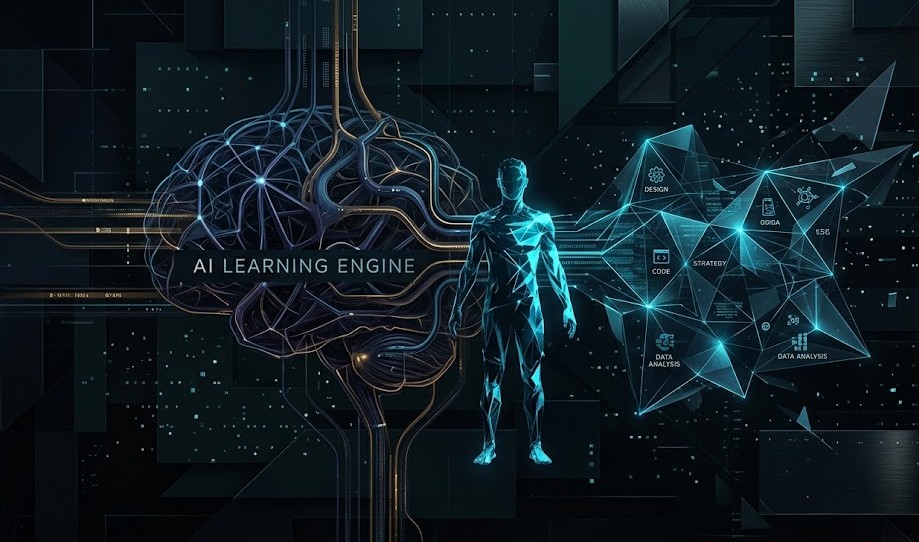
There are people everywhere who are talented at multiple things. They plateau not because they lack ability — but because they lack infrastructure. The tools to act on their full range of capability simply weren't available to them. That gap between potential and output has defined careers, industries, and entire generations of talent.
AI is about to close that gap permanently.
First, understand the T.
The T-shaped profile has been the professional ideal for decades. The vertical bar represents deep expertise in one domain. The horizontal bar represents broad knowledge across multiple disciplines — design, strategy, communication, data, product, whatever the context demands.
For most of history, building the horizontal bar was expensive. It required time, resources, mentors, and access that most people simply didn't have. The people who managed it were either exceptionally resourced, exceptionally connected, or exceptionally stubborn about self-teaching across domains while holding down everything else.
The World Economic Forum's Future of Jobs 2025 report warns that 39% of workers' core skills will be transformed by 2030. Most people read that as a threat. It's actually the largest opportunity redistribution in a generation.
Because AI just made the horizontal bar accessible to everyone.
A designer who understands strategy but couldn't write code can now build a working prototype. A marketer who understands data but couldn't build dashboards can now run their own analytics. A founder who understands product but couldn't write copy can now produce campaign-level content. The bottleneck between knowing what you want to do and being able to do it has collapsed.
The T-shaped professional is no longer the ceiling. It's the starting point.
Now meet the E.
Andreessen argues we're moving from a T-shaped to an E-shaped approach to career development — referencing Scott Adams' insight that being good at two things creates more than double the value, and three things more than triple.
Adams became spectacularly successful with Dilbert not because he was the world's greatest cartoonist or the best business person, but because he was a cartoonist who deeply understood business. The additive effect of being good at multiple things is more than double or triple the value — because it creates a rare specialist in the combination of domains.
The E-shaped professional has multiple bars of genuine depth — not just one vertical and a broad horizontal, but two or three areas of real capability built on a foundation of domain expertise. AI is what makes building those additional bars achievable within a single career rather than across multiple lifetimes.
Every coder now believes they can also be a product manager and designer because they have AI. Every product manager thinks they can code and design. Every designer knows they can do the other two roles. And they're all essentially correct — because AI is genuinely good at all three functions.
The traditional stovepipe career — go deep, stay narrow, hand off everything else — is being replaced by something far more interesting. People who were always multi-dimensional but never had the tools to act on it are about to become the most valuable people in any room.
The progression looks like this.
You start as a specialist. You build the T by using AI to develop breadth across adjacent disciplines. Then you deepen a second bar. Then a third. Each combination becomes exponentially rarer and more valuable than its individual parts. The skill stack compounds in a way that a single domain of expertise never could.
83% of employees believe AI will make uniquely human skills even more critical. They're right. But the people who benefit most won't be narrow specialists or unfocused generalists. They'll be the ones who were always good at multiple things — and never had the infrastructure to act on all of it simultaneously. AI doesn't replace their judgment. It removes every excuse for not acting on it.
The future of work depends less on AI replacing people and more on people using AI to amplify the potential of humans and their contributions. As routine tasks fade, employees can focus on work that carries meaning.
What this means practically.
The question is no longer "what can I do?" It's "what am I good enough at to direct AI to do well?" That's a fundamentally different skill — and it rewards taste, judgment, and domain knowledge above everything else. The things that actually separate great people from average ones.
AI excels at pattern recognition, anomaly detection, and predictive modelling — capabilities that accelerate human decision-making while preserving human accountability. The human still owns the vision. The human still owns the judgment call. AI just removes the bottleneck between the idea and the output. That's not a small thing. That's the difference between a good person and a great one.
The most valuable professionals will be superpowered individuals who combine capabilities across domains — building and designing products from scratch, which is the most valuable capability of all.
The T-shaped professional was always the ideal. The E-shaped professional is where AI takes you next.
"AI is going to take people who are good at doing things and make them very good. And it's going to make the people who are great at doing things and make them spectacularly great."
— Marc Andreessen, Lenny's Podcast, January 2026
Why this matters to us at Perforange.
We're building India's first structured esports development program for schools. AI is central to what we're building — not because it's the obvious thing to add to an edtech product, but because the problem we're solving is fundamentally the same one this article is about.
Students in our program don't just develop as players. The performance tracking layer diagnoses exactly which skill is holding each student back and prescribes the specific intervention to fix it. The career pathway system identifies whether a student's cognitive profile points toward analysis, content creation, event production, or competitive play — and routes them accordingly. The wellness engine ensures they're developing sustainably, not just grinding toward burnout.
That's the E-shaped model applied to a 16-year-old who's never heard of Marc Andreessen. A student who enters Perforange as a Valorant player exits as someone who understands performance data, can communicate their own development journey, and has a credential in a specific domain of the esports industry — regardless of whether they ever go pro.
Technology should democratize talent. Every student who comes through a structured program like this gets access to something that used to require expensive coaches, elite academies, and the right connections. AI makes that infrastructure available at school scale.
That's the world we're building toward. And it starts earlier than most people think.
Sources:
Marc Andreessen on Lenny's Podcast, January 2026: https://www.lennysnewsletter.com/p/marc-andreessen-the-real-ai-boom
WEF Future of Jobs Report 2025: https://www.weforum.org/stories/2025/01/future-of-jobs-report-2025-jobs-of-the-future-and-the-skills-you-need-to-get-them/
T to E-shaped careers — UX Tigers: https://www.uxtigers.com/post/time-to-build
WEF on elevating human skills: https://www.weforum.org/stories/2025/01/elevating-uniquely-human-skills-in-the-age-of-ai/
Andreessen on generalists and AI: https://officechai.com/ai/generalists-will-thrive-in-the-age-of-ai-marc-andreessen/
Pinnacle on Andreessen's career frameworks: https://www.heypinnacle.com/blog/jobs-persist-marc-andreessen-2026
TechRadar — AI amplifying human potential: https://www.techradar.com/pro/the-agentic-future-why-ais-greatest-power-is-amplifying-human-potential
Related Reading
Continue down this track.
 Founder's Journal
From Stadium to Arena: The Digital Sports Era and the Future of Human Capability
Expanding the boundaries of human potential, our platform bridges the steep learning curve of digital sports by transforming raw gameplay and comms into automated post-game coaching and squad accountability.
 Founder's Journal
Paper Rex Didn't Wait for Permission — Neither Should India. The Train is Leaving.
Paper Rex didn't wait for the world to believe in Southeast Asia. India is still waiting for someone to believe in us.
 Founder's Journal
Your Student Who Games Isn't Wasting Their Brain. They're Building It.
The student who knows a game's meta in forensic detail isn't wasting their brain — they're building one that most classrooms never thought to develop.