Founder's Journal
Your Student Who Games Isn't Wasting Their Brain. They're Building It.
The student who knows a game's meta in forensic detail isn't wasting their brain — they're building one that most classrooms never thought to develop.
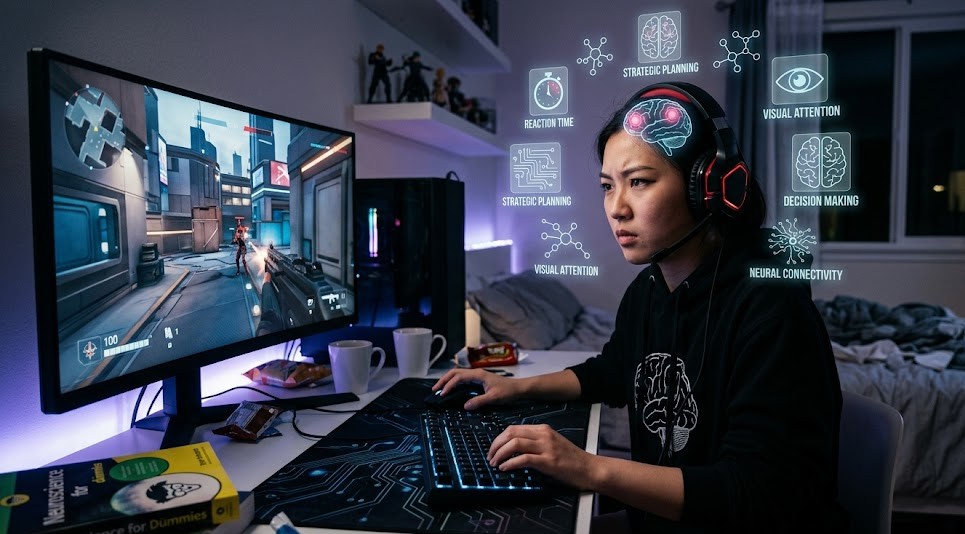
There is a conversation happening in school staffrooms across India that goes something like this.
A teacher raises a concern about a student — bright, capable, but disengaged in class. Doesn't participate. Doesn't seem motivated. But apparently stays up late playing games and knows the meta of Valorant in forensic detail. The conversation ends the way it usually does: someone sighs and says something about wasted potential.
Here is what that conversation gets wrong.
The student who knows the game meta in forensic detail is not wasting their potential. They are exercising a sophisticated cognitive architecture — pattern recognition, probabilistic reasoning, spatial awareness, decision-making under uncertainty, emotional regulation under pressure — that most classroom environments never deliberately develop. The question is not whether gaming is building something in that student's brain. The research now makes clear that it is. The question is whether any adult in that student's life is paying attention to what is being built, and whether there is a structure in place to develop it further.
This piece is about that cognitive architecture — what gaming actually builds in the brain, how different genres build different things, and why schools that understand this are in a position to do something genuinely valuable for a generation of students that the current curriculum was not designed for.
The Science Has Moved On
For years, the research on gaming and cognition was a battlefield. Studies on one side showed improvements in attention and spatial reasoning. Studies on the other showed links to reduced attention spans and impaired memory. Parents and educators looking for clear guidance found contradictory headlines and gave up trying to form an evidence-based view.
The science has moved on significantly in the last two years. A comprehensive body of research published in 2024 and 2025 has produced findings that are more specific, more nuanced, and more useful than anything that came before.
A plethora of research has demonstrated that habitual action video gamers show superior information processing, attention, task switching, and memory abilities compared to non-gaming populations. Moreover, research has found these same cognitive skills can be enhanced when non-gamers engage with action video games.
Gaming skills positively affect executive function, memory, overall cognition, cognitive flexibility, and emotion recognition. Critically, various game genres have different effects on cognitive and affective abilities — with executive functions specifically boosted by action, strategy, and puzzle games.
This genre-specificity is the most important development in the research. Gaming is not one thing. A student playing a first-person shooter is engaging a fundamentally different set of cognitive systems than a student playing a real-time strategy game. Both are building something real. But they are building different things. Understanding what each genre builds is the foundation of intelligent esports education.
What FPS Games Build — The Precision Cognition Layer
First-person shooters — Valorant, Counter-Strike 2, Rainbow Six Siege — are often dismissed as the most mindless category of gaming. Point and shoot. Fast twitch. No thinking required.
This is almost entirely wrong.
Research on professional FPS players specifically identifies action reprogramming and inhibitory control as the essential cognitive abilities for FPS success — so essential that targeted cognitive training interventions using these abilities led to significant improvements in esports performance over five months of structured training.
What does action reprogramming mean in plain terms? It means the ability to abort a planned movement mid-execution and replace it with a different one — instantly and accurately. In Valorant, this looks like a player who begins peeking a corner, sees an unexpected threat from a different angle, aborts the peek, and repositions in under 200 milliseconds. In real life, this cognitive ability maps to rapid adaptation to changing circumstances — the capacity to abandon a failing plan and execute a new one without freezing.
This is not a skill that traditional schooling develops deliberately. Mathematics rewards careful, sequential execution of a known method. Literature rewards sustained engagement with a single text. Both are valuable. Neither produces the rapid adaptive decision-making that FPS games train constantly.
Neuroimaging research using fMRI has found that viewing FPS gameplay activates significantly different cortical networks than other game genres — specifically engaging higher-order processing networks associated with attention control and rapid decision-making.
Beyond the neurological evidence, FPS games build a specific form of spatial intelligence that is directly applicable outside gaming. A player who has spent hundreds of hours learning the map geometry of Valorant's Haven or CS2's Inferno has developed an unusually precise ability to maintain and update a three-dimensional mental model of their environment while simultaneously tracking multiple moving agents within it. This is the same cognitive capacity that architects, surgeons, and air traffic controllers use professionally — developed, in this case, through thousands of hours of play.
The confidence dimension in FPS:
Confidence in FPS gaming is not simply a psychological state — it is a measurable performance variable. A player who enters a clutch round tilted, uncertain, or cognitively fatigued performs measurably worse than the same player entering the same situation with composure and confidence. Research from USC specifically identifies self-efficacy and perceived control as the skills that facilitate effective emotion regulation and tilt management in esports athletes.
What this means practically: every time a student successfully executes a difficult play — a 1v3 clutch, a perfectly timed entry into a site, a game-winning call under pressure — their self-efficacy increases. Not just their in-game confidence. Their generalized belief in their capacity to perform under pressure. This is a transferable psychological asset that conventional schooling rarely produces in students who struggle with academic performance but thrive in competitive gaming environments.
What Strategy Games Build — The Systems Cognition Layer
Real-time strategy games — DOTA 2, League of Legends — operate at a completely different cognitive altitude from FPS games. Where FPS builds precision and rapid adaptation, strategy builds something that researchers are increasingly calling systems cognition: the ability to understand, model, and manipulate complex adaptive systems simultaneously.
A DOTA 2 player at a mid-level of competence is simultaneously managing: their hero's ability cooldowns, their resource economy (gold and experience), the positioning of five allied heroes, the suspected positioning of five enemy heroes, the state of three lanes, two jungles, and multiple objective timers, plus the macro-strategic state of the game — which team has the stronger late game, which objectives are most valuable to contest right now, and what the enemy team's win condition is.
This is not multitasking in the shallow sense. It is the management of a genuinely complex system with dozens of interdependent variables — the kind of cognitive demand that traditionally only appears in advanced professional contexts like financial trading, military command, or large-scale project management.
Research published in Frontiers in Education identifies that video games are particularly powerful tools for developing metacognitive strategies because they provide dynamic scenarios where players must regulate their thought processes to succeed — including planning before starting a task and setting goals, monitoring progress and adjusting strategies during the task, and evaluating performance afterward.
This metacognitive loop — plan, execute, monitor, adjust, evaluate — is the cognitive architecture of every high-performing professional discipline. Schools attempt to teach it through project work and assessments. Strategy games teach it continuously, in real time, with immediate feedback, across thousands of iterations. The learning rate is dramatically higher.
Pattern recognition in strategy games:
The pattern recognition that strategy games develop is qualitatively different from FPS pattern recognition. In FPS, patterns are local and immediate — the sound of a footstep telling you where an enemy is, the flash of a muzzle telling you which angle to avoid. In strategy games, patterns are global and temporal — recognizing that the enemy team's behavior in the last ten minutes indicates they are setting up a specific objective play, and positioning your team to counter it before they execute.
This is the difference between reading a sentence and reading a paragraph. Both require pattern recognition. One operates at the level of individual words. The other operates at the level of narrative structure. The strategy game player who can look at a DOTA 2 game state and say "they're going for Roshan in the next ninety seconds" is performing a sophisticated inferential act — reading multiple weak signals simultaneously and synthesizing them into a confident probabilistic prediction. That cognitive skill transfers directly into any domain where reading complex situations and making probabilistic predictions is valuable. Which is most of the important domains.
A 2024-2025 study on League of Legends players found direct improvements in cognitive functioning — including decision-making in risky and ambiguous conditions — when compared to control groups, with Gold-rank and above players specifically demonstrating superior judgement in complex decision-making tasks.
What Mixed-Genre Play Builds — The Integration Layer
The most cognitively sophisticated students are often the ones who move fluidly between genres — playing Valorant with friends one evening and DOTA 2 the next, or building strategies in a session of Rainbow Six Siege and then decompressing with a management simulation. This cross-genre play builds something that single-genre play cannot: cognitive flexibility.
Research on video game skills across diverse genres found significant improvements in verbal and visuospatial short-term and working memory, hand-eye coordination, and — notably — empathy, with genre diversity correlating with broader cognitive benefits than single-genre specialization.
Cognitive flexibility — the ability to switch between different cognitive modes on demand — is one of the most reliably predictive indicators of adult professional performance across domains. It is what allows a person to zoom out from detail to strategy, and back again, without losing their place in either. It is what allows a leader to hold a detailed technical conversation and then immediately switch to a high-level stakeholder discussion without confusing the two registers.
Multi-genre gamers develop this flexibility naturally. The mental mode required to play Valorant effectively — fast, reactive, spatially precise — is almost the opposite of the mode required to play DOTA 2 effectively — slow, deliberate, systems-oriented. A student who can switch between these modes within the same week is exercising their cognitive flexibility in a way that no single-subject curriculum achieves.
Research published in 2025 in PMC found that puzzle games specifically are associated with improvements in logical reasoning and pattern recognition, while simulation games promote decision-making and planning — further evidence that the genre mix a student engages with directly shapes the specific cognitive profile they develop.
Confidence — The Most Undervalued Output
Of all the cognitive and psychological benefits that gaming produces, confidence is the most consistently undervalued — because it is the hardest to measure and the easiest to dismiss as a soft outcome.
It is not soft. It is structural.
A student who is failing academically has, in most school environments, very limited opportunities to experience genuine mastery. They receive feedback that is predominantly corrective — red marks, low grades, disappointed expressions. Their model of themselves as learners is built on a long series of experiences of inadequacy. This is not a discipline problem or a motivation problem. It is a confidence architecture problem.
Gaming provides something that traditional schooling cannot easily manufacture: a mastery experience that is proportional to effort and visible in real time. A student who grinds for three months to improve their crosshair placement, watches their headshot percentage climb from 18% to 31% in their Perforange OS dashboard, and sees their school ranking rise from 40th to 18th has had a concrete, measurable, irrefutable experience of improvement. They worked at something hard. They got better at it. The data confirms it.
That experience — repeated across hundreds of sessions — builds a specific psychological structure that researchers call self-efficacy: the belief that one's effort produces results. Self-efficacy and perceived control are identified in recent research as the skills that facilitate effective emotion regulation and sustained engagement in competitive gaming — and interventions targeting these qualities have been shown to improve resilience and reduce burnout in esports athletes.
The student who has built genuine self-efficacy through gaming carries that structure into every other domain of their life. Not because gaming made them smarter — but because gaming gave them an experience of their own competence that they did not get elsewhere. That experience changes how they approach difficulty. It changes their relationship with failure. It changes what they believe they are capable of.
This is why the confidence output of a well-structured school esports program is arguably more valuable than the performance output. A student who becomes a better Valorant player is better at Valorant. A student who develops self-efficacy through the process of becoming a better Valorant player is better at life.
Genre-Specific Cognitive Profiles — A Reference for Educators
For school administrators and PE faculty designing esports programs, understanding the cognitive profile of each genre helps you make intentional decisions about which titles to include, how to structure sessions, and what outcomes to track.
First-Person Shooters (Valorant, CS2, Rainbow Six Siege): Primary cognitive outputs — rapid adaptive decision-making, spatial awareness, inhibitory control, action reprogramming, sustained attention under pressure. Secondary outputs — communication precision, emotional regulation under stress, confidence through measurable performance improvement.
Real-Time Strategy and MOBA (DOTA 2, League of Legends): Primary cognitive outputs — systems thinking, pattern recognition at scale, metacognitive planning, probabilistic reasoning, resource management. Secondary outputs — leadership, long-term strategic thinking, team coordination, delayed gratification.
Mixed or Multi-Genre Play: Primary cognitive outputs — cognitive flexibility, adaptive transfer of skills, broader working memory, perspective-taking. Secondary outputs — resilience through genre-switching, reduced cognitive rigidity, broader social awareness through diverse game communities.
What This Means for Your School
If you are running or planning an esports program, the research gives you a clear mandate that goes beyond simply providing students with a competitive activity.
You are running a cognitive development program. The titles you choose determine which cognitive systems you are deliberately exercising. The session structure you implement determines whether the cognitive benefits compound or dissipate. The feedback you give students — through telemetry data, coach observation, and performance tracking — determines whether the confidence outputs are built intentionally or left to chance.
A student who plays Valorant for two hours with no structure, no feedback, no wellness monitoring, and no pathway forward walks away having exercised their brain in ways that are real but undirected. A student who plays Valorant for ninety minutes with structured breaks, performance telemetry reviewed by a trained faculty member, a specific improvement goal set at the start of the session, and a career pathway that gives their progress meaning walks away having invested in their own cognitive and professional development.
The difference between those two students is not the game. It is the program surrounding the game.
That is what a school esports program is for. Not to legitimize gaming. Not to keep students engaged. But to take the cognitive development that gaming produces naturally and make it deliberate, measurable, and directed toward outcomes that matter.
The student who knows Valorant's meta in forensic detail already has a remarkable brain. The question is who is going to help them build on it.
Perforange OS tracks student performance across FPS, MOBA, and strategy titles — combining real-time analytics with wellness monitoring and career pathway guidance to turn unstructured gaming into structured cognitive development. If you are a school administrator building an esports program, we would like to show you what that looks like in practice.
Sources & Citations
¹ Campbell, M.J., Toth, A.J., Moran, A.P., King, N., & Brady, N. (2021). Editorial: Progress in Computer Gaming and Esports: Neurocognitive and Motor Perspectives. Frontiers in Psychology. Habitual action video gamers demonstrate superior information processing, attention, task switching, and memory abilities compared to non-gaming populations — and these skills can be enhanced in non-gamers through action video game engagement. https://www.ncbi.nlm.nih.gov/pmc/articles/PMC8100197/
² Zioga, T., Ferentinos, A., Konsolaki, E., Nega, C., & Kourtesis, P. (2024). Video game skills across diverse genres and cognitive functioning in early adulthood. Behavioral Sciences, 14(10). Genre-specific gaming skills positively affect executive function, memory, overall cognition, cognitive flexibility, and emotion recognition, with action and strategy genres specifically boosting executive functions.
³ Zakalski, J. & Hart, E. (2024). Cognitive training interventions for professional female FPS esports athletes. Journal of Electronic Gaming and Esports, 2(1). Action reprogramming and inhibitory control identified as essential cognitive abilities for FPS success, with targeted 5-month training interventions producing significant improvements in esports performance. https://journals.humankinetics.com/view/journals/jege/2/1/article-jege.2024-0058.xml
⁴ Lim et al. (2025). Rewiring Young Minds: Investigating the Cognitive Effects of Video Games on Learning and Their Potential as Digital Therapeutics for Mental Well-Being. PMC, open access. Puzzle games associated with improvements in logical reasoning and pattern recognition; simulation games promote decision-making and planning. https://pmc.ncbi.nlm.nih.gov/articles/PMC12326338/
⁵ Frontiers in Education (2024). Video games and metacognition in the classroom for the development of 21st century skills. Engaging with video games helps players build cognitive flexibility, self-monitoring, and strategic thinking — all core components of metacognitive growth. https://www.frontiersin.org/journals/education/articles/10.3389/feduc.2024.1485098/full
⁶ Poulus, D. et al. (2024). Esports, Mental Toughness and Resilience. USC Research Bank. Self-efficacy and perceived control facilitate effective emotion regulation and tilt management; interventions targeting these qualities improve resilience, mental health, and sustained engagement in esports athletes. https://research.usc.edu.au/
⁷ Deng, S.C., Li, J.H., Liu, X.Y. et al. (2024). Demonstration of superior judgement? Exploring League of Legends players' performance in risky and ambiguous decision-making tasks. Acta Psychologica, 251, 104630. Gold-rank and above LoL players demonstrated superior judgement in complex decision-making tasks compared to control groups.
⁸ ScienceDirect (2024). Co-activation patterns during viewing of different video game genres. FPS and action real-time strategy game viewing activates significantly different cortical networks from other genres, with ARSG specifically eliciting more pronounced engagement of attentional control networks. https://www.sciencedirect.com/science/article/pii/S0361923024001072
Tags: gaming cognitive development schools India, esports education benefits, FPS pattern recognition, strategy games brain development, school esports program India, gaming confidence students, DOTA 2 cognitive skills, Valorant brain development, Perforange, esports learning India, cognitive benefits gaming students
Related Reading
Continue down this track.
 Founder's Journal
From Stadium to Arena: The Digital Sports Era and the Future of Human Capability
Expanding the boundaries of human potential, our platform bridges the steep learning curve of digital sports by transforming raw gameplay and comms into automated post-game coaching and squad accountability.
 Founder's Journal
The Infrastructure of Greatness: How AI Rewires the Ceiling on Human Potential
The gap between what you're capable of and what you can execute has just collapsed.
 Founder's Journal
Paper Rex Didn't Wait for Permission — Neither Should India. The Train is Leaving.
Paper Rex didn't wait for the world to believe in Southeast Asia. India is still waiting for someone to believe in us.