Faculty Corner
The Tilt Problem: Why Your Best Student Gamer Underperforms After 90 Minutes — And What the Data Says
Your best student gamer isn't losing focus because of poor discipline — they're losing it because no one is watching the clock.
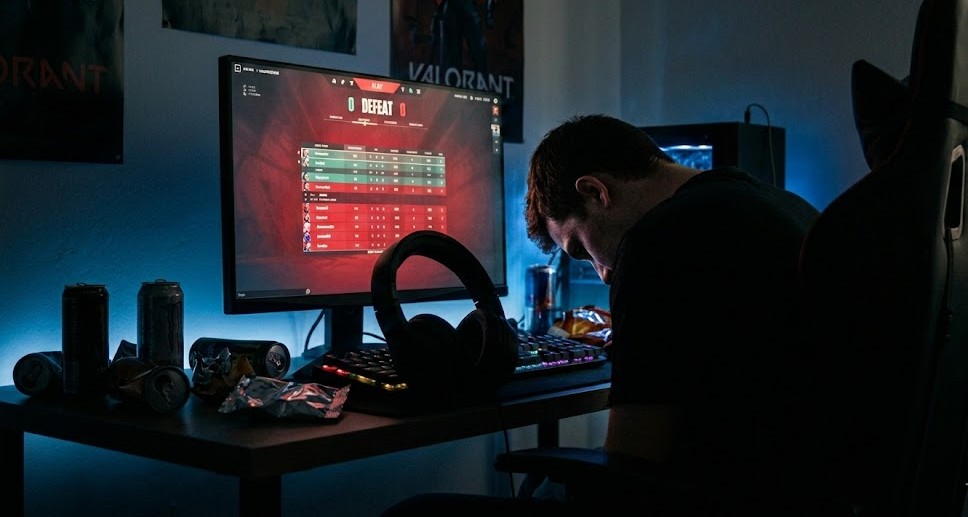
You've seen it happen.
A student who is sharp, focused, and making excellent decisions in the first hour of a session becomes a completely different player by the ninety-minute mark. Their reaction time slows. Their communication deteriorates. They start making aggressive, impulsive calls that cost their team rounds. They rage at teammates. They queue up for one more game even though they clearly shouldn't.
In the gaming community, this state has a name: tilt.
In the school context, it has a different name: a reason why parents don't want gaming in labs.
What most school administrators don't know — and what the research is now clearly establishing — is that tilt is not a character flaw, a discipline issue, or evidence that gaming is harmful. It is a predictable, measurable, and manageable physiological and psychological response to prolonged cognitive stress. It works the same way fatigue works in any sport. And like fatigue in sport, it can be monitored, anticipated, and mitigated with the right systems in place.
This piece is for the principals and PE faculty who are being asked to manage esports programs in their schools. Because understanding tilt is not just a gaming concept — it is the foundation of responsible esports education.
What Tilt Actually Is
The word comes from pinball. A player who shook the machine too aggressively — out of frustration — would trigger the tilt sensor and freeze the game. The metaphor migrated into poker in the 1970s to describe a player so emotionally destabilized by losses that they begin making irrational bets. Competitive gaming borrowed it from there.
In the esports context, tilt is now the subject of serious academic inquiry. Research published in 2025 in the journal Cyberpsychology, Behavior, and Social Networking by researchers at the University of Limerick defines it as a multifaceted state that incorporates negative emotions and behavior, hinders cognition, and results in poor in-game performance. ¹ The same research identified that tilt is not a single emotional event — it is a cascade. A frustrating loss triggers an emotional response. That emotional response impairs decision-making. Impaired decision-making produces more losses. More losses deepen the emotional response. The cycle compounds rapidly.
For a school-age student, who has less emotional regulation capacity than an adult and significantly higher susceptibility to social pressure from teammates, the cascade accelerates faster and hits harder.
The 90-Minute Threshold
The question of when exactly performance begins to decline has been studied with increasing precision.
Research published in Scientific Reports in 2025 examining the effects of progressive gaming sessions on cognitive performance found a clear dose-response relationship. Performance improved in shorter sessions of around twenty minutes compared to baseline. But it declined measurably during longer sessions of thirty and forty minutes — a pattern that researchers described as initially enhancing performance followed by cognitive fatigue and decreased efficiency in prolonged sessions. ²
For competitive esports titles — where a single Valorant or CS2 match can run forty to fifty minutes — the implications are direct. By the time a student completes two full competitive matches, they are past the point where their cognitive performance is at its peak. The third match is being played in a fatigued state. Their decision speed, spatial awareness, communication clarity, and emotional stability are all measurably lower than they were ninety minutes earlier.
This is not an opinion. It is a dose-response relationship supported by multiple independent research streams.
The same pattern holds in the neurological literature. A 2024 study from the University of Limerick — one of the leading research centers for eSports psychology — found that even experienced gamers with superior baseline cognitive abilities are not more resilient to cognitive fatigue than non-gamers. ³ Training does not protect you from the fatigue curve. It only changes what your baseline looks like before the curve begins.
What Tilt Looks Like in a School Lab — And Why It Matters for You
As a principal or PE teacher, you may not recognize tilt by that name. But you will recognize its symptoms.
The student who was cooperative in the first session becomes short-tempered and dismissive of teammates. The student who was making thoughtful strategic calls starts playing recklessly, taking duels they have no business taking. The student who was managing their emotions well after a loss starts slamming desks or throwing headsets. The student who should have logged off thirty minutes ago is demanding one more game.
These are not discipline problems in the traditional sense. They are the predictable downstream effects of unmanaged cognitive and emotional fatigue in a high-stakes competitive environment. Treating them as behavioral issues without addressing the underlying physiological state is like punishing a footballer for cramping.
The reason this matters specifically for school administrators is that these incidents — if unmanaged — become the evidence that critics of school esports use to shut programs down. A single viral story about a student losing their temper in a school gaming lab does more damage to the legitimacy of esports education than years of positive outcomes can repair.
The question is not whether tilt will happen in your lab. It will happen. The question is whether you have the systems to detect it before it becomes a problem, manage it when it emerges, and prevent it from becoming a pattern.
Three Things That Make Tilt Worse in School-Age Students
Session length without structured breaks. The research is consistent: moderate duration gaming optimizes cognitive performance, excessive duration degrades it. ² Without a structured break protocol — specifically the ophthalmologically recommended 20-20-20 rule (every twenty minutes, look at something twenty feet away for twenty seconds) combined with physical movement breaks — fatigue accumulates faster than the student is aware of. They feel like they are still performing at their peak when the data shows otherwise.
Loss streaks without emotional reset mechanisms. Competitive gaming punishes losing runs with ranking deterioration — which, for a school-age student whose social identity is partly tied to their in-game rank, creates a pressure cycle that adults underestimate. Without a structured mechanism for emotional reset after a loss — a debrief, a breathing exercise, a mandatory break — students re-queue into their next match already tilted from the last one.
No external monitoring. In traditional sport, a PE teacher can see that a student is physically exhausted. They can watch posture deteriorate, breathing change, and movement slow. In esports, the equivalent signals are behavioral and digital — communication tone, decision frequency, error rate, rage-quit patterns — and they are invisible unless you are specifically tracking them. Most school gaming programs have no mechanism to capture these signals at all.
What a Managed Approach Looks Like
The good news is that tilt is manageable. Professional esports organizations have known this for years — which is why tier-one teams employ sports psychologists, enforce session limits, and have structured cool-down protocols after losses. The same approach is deployable at school level, and it does not require expensive infrastructure.
It requires three things.
Session time limits with enforcement. Not guidelines. Enforced limits. A student who knows they will be automatically locked out of the system after ninety minutes of competitive play has a structurally different relationship with session management than one who is relying on their own willpower to stop. Automated session limits — with faculty override available for structured competition — remove the willpower burden from the student and place it in the system where it belongs.
Break protocols built into the program. Structured breaks at forty-five and ninety minutes, including a mandatory physical movement component and a short breathing exercise, reduce cognitive fatigue accumulation significantly. These are not interruptions to the program — they are part of the program. The same way a PE lesson builds in hydration breaks and cool-downs, an esports session should build in cognitive reset moments.
Behavioral monitoring that flags early warning signs. A student's in-game behavior contains early indicators of tilt that appear before the behavioral breakdown becomes visible in the lab. Communication frequency drops. Error rate increases. Decision speed slows. Aggressive tactical choices increase. Monitoring these signals — even through basic session analytics — allows a trained faculty member to intervene early, before the emotional state becomes unmanageable.
What This Means for Your School's Gaming Program
If you are running or planning a school esports program, the tilt problem is the single most important operational challenge you will face. More important than hardware. More important than which titles you select. More important than coaching credentials.
Because a program that cannot manage tilt cannot justify itself to parents, to your school board, or to regulatory bodies. Every incident that stems from unmanaged cognitive fatigue becomes a story about gaming being harmful — regardless of everything else the program achieves.
But a program that actively monitors student wellness, enforces session limits, builds in structured breaks, and trains faculty to recognize and respond to early tilt signals is a completely different proposition. It is a program that can look any skeptical parent in the eye and show them the data — session logs, wellness indicators, behavioral records — that demonstrate their child is being cared for, not just entertained.
That is the program worth building. And the data to build it on already exists.
Perforange OS monitors student wellness in real time — tracking session duration, posture, eye strain risk, communication patterns, and tilt index across every lab session. Faculty receive automated alerts when a student's indicators suggest early-stage cognitive fatigue, enabling structured intervention before performance and behavior deteriorate. If you are a school administrator exploring what responsible eSports education looks like in practice, we would like to have that conversation.
Sources & Citations
¹ Cregan, S.C., Toth, A.J. & Campbell, M.J. (2025). The Psychology of Tilt: Understanding Tilt and Coping Strategies in Video Games. Cyberpsychology, Behavior, and Social Networking. Mary Ann Liebert, Inc. Tilt was found to be multifaceted, incorporating negative emotions and behaviour, hindering cognition, and resulting in poor in-game performance. https://journals.sagepub.com/doi/10.1089/cyber.2024.0320
² Alajlan, S.M., Boughattas, W. et al. (2025). Effects of progressive gaming sessions on cognitive awareness among Saudi education university students. Scientific Reports, Nature Publishing Group. Performance improved during 20-minute sessions compared to baseline but declined during longer sessions of 30 and 40 minutes, consistent with a dose-response relationship between gaming duration and cognitive output. https://www.nature.com/articles/s41598-025-04594-0
³ Campbell, M.J., Cregan, S.C., Joyce, J.M., Kowal, M. & Toth, A.J. (2024). Comparing the cognitive performance of action video game players and age-matched controls following a cognitively fatiguing task: A stage 2 registered report. British Journal of Psychology, 115(3), 363–385. Experienced gamers showed superior baseline cognitive abilities but were not more resilient to cognitive fatigue than non-gamers. https://pubmed.ncbi.nlm.nih.gov/38140897/
Tags: esports wellness schools India, gaming tilt students, school esports program India, student gaming health, esports cognitive fatigue, gaming session limits schools, Perforange, esports education India, PE faculty esports, gaming burnout students
Related Reading
Continue down this track.
 Founder's Journal
From Stadium to Arena: The Digital Sports Era and the Future of Human Capability
Expanding the boundaries of human potential, our platform bridges the steep learning curve of digital sports by transforming raw gameplay and comms into automated post-game coaching and squad accountability.
 Founder's Journal
The Infrastructure of Greatness: How AI Rewires the Ceiling on Human Potential
The gap between what you're capable of and what you can execute has just collapsed.
 Parent Zone
The Biological Clock Nobody Talks About — Why Your Child’s School Years Are Their Esports Peak
While Indian students wait for graduation, their global peers are winning championships; science says 22 is already too late for esports.