Parent Zone
Your Child Isn't Less Intelligent. The School Just Isn't Measuring What They're Good At.
The report card wasn't wrong about your child. It was just measuring the wrong things.
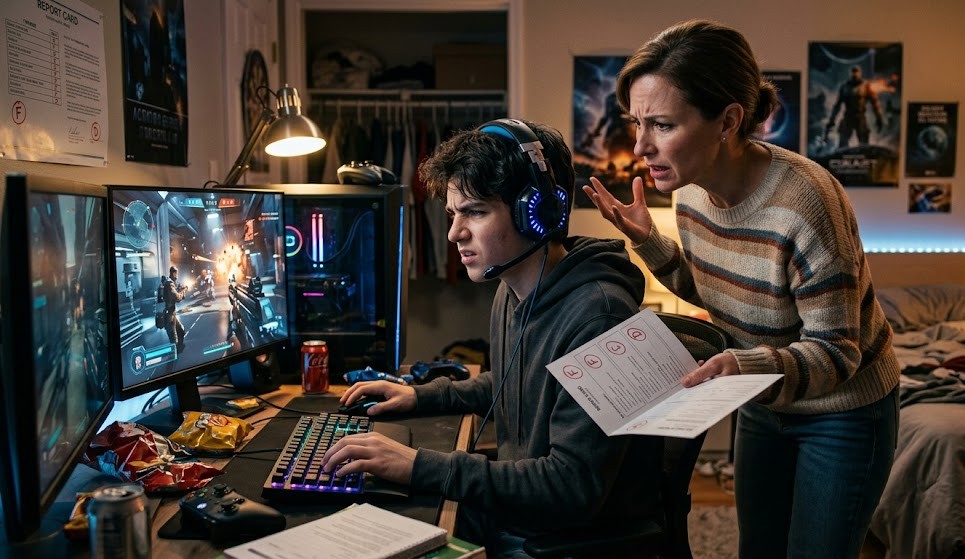
There is a report card conversation that happens in millions of Indian households every year.
The marks come home. They are not what was hoped for. There is disappointment, then worry, then a familiar sequence of conclusions — not working hard enough, too distracted, wasting time on games. The child sits through it, says little, and goes back to their room.
What neither the parent nor the child has the language for is this: the report card measured a narrow set of cognitive abilities and found them wanting. It said nothing — not one word — about the spatial reasoning that allows this same child to navigate a complex three-dimensional environment under time pressure while simultaneously tracking five moving targets. It said nothing about the strategic intelligence that lets them read an opponent's pattern after three rounds and adjust their entire approach. It said nothing about the communication precision they deploy in a competitive team, or the emotional regulation they exercise when they lose a close game and queue up again without collapsing.
The report card was not wrong. It was incomplete. And the difference between those two things is enormous — for the child, for the parent, and for what India is capable of becoming.
The Problem With One Kind of Smart
In 1983, a Harvard developmental psychologist named Howard Gardner proposed something that was, at the time, genuinely radical. Intelligence, he argued, was not a single measurable quantity. It was not the number that emerged from an IQ test or the aggregate of marks across school subjects. It was a complex web of at least seven distinct abilities — each with its own neurological substrate, its own developmental trajectory, and its own form of expression.
Gardner's theory suggests that human intelligence is not a single entity that can be measured by traditional IQ tests, but rather a complex interplay of various abilities. He identified initially seven distinct types of intelligences: linguistic, logical-mathematical, musical, bodily-kinesthetic, spatial, interpersonal, and intrapersonal — with naturalistic and existential intelligences added later.
The implications of this were significant. A child who struggles with linguistic and logical-mathematical intelligence — the two types that school examinations primarily test — might have exceptional spatial intelligence. Or extraordinary interpersonal intelligence. Or a bodily-kinesthetic intelligence that makes them a natural athlete, a dancer, or a surgeon. By the standards of a report card, they look like an underachiever. By the standards of their actual cognitive profile, they may be exceptionally gifted — just not in the ways that the system was built to recognize.
Gardner advocated for a radical shift, arguing that standardized assessments fail to fully capture the diverse abilities of individuals. More than four decades later, the Indian school system has largely not made that shift. The report card still measures the same two intelligences it always has, in approximately the same way, and draws approximately the same conclusions about children who excel in other directions.
The child who games is often one of those children. And what their gaming reveals — if anyone looks carefully — is frequently a cognitive profile of considerable sophistication.
What Intelligence Actually Looks Like in a Gaming Context
When a parent watches their child gaming, they typically see the surface: a screen, a controller or keyboard, rapid movement, occasional intense focus. What they do not see — because it is invisible — is the cognitive activity underneath.
Take a fifteen-year-old playing Valorant at a competitive level. In the two seconds before they push a corner, they have processed the following: the last known position of three enemy players, the probability distribution of where the fourth and fifth might be given the time elapsed since they were last spotted, the state of their own team's positioning, whether their abilities are available and how to deploy them optimally, the sound cues from the previous five seconds, and the meta-context of the round — whether their team needs to play aggressively or conservatively given the economy state.
None of this is conscious deliberation. It is pattern recognition and probabilistic reasoning operating at speed, built through thousands of hours of structured repetition. It is, by any rigorous definition, intelligent behavior.
Now consider the same fifteen-year-old in a mathematics examination. They struggle with the notation. They lose track of multi-step procedures. They freeze under time pressure in a way they never do in a clutch round. The exam concludes they are not particularly intelligent. The game knows differently.
Gardner's research has explored the need for individualised education, opposing pedagogical efforts that make education uniform and apply the same one-size approach to all students. The gaming child is the clearest possible argument for why uniform measurement produces misleading conclusions.
The Nine Intelligences — and Where Gaming Lives
Understanding Gardner's framework helps parents see their child's gaming not as an obstacle to intelligence but as an expression of it.
Spatial intelligence — the ability to think in three dimensions, to navigate and manipulate mental models of physical space — is perhaps the most directly developed by first-person shooter games. A competitive Valorant player has an extraordinarily precise spatial intelligence. They can hold a mental map of an entire environment while tracking the movement of multiple agents within it, update that model in real time based on sound and visual cues, and execute spatial decisions under pressure with a speed and accuracy that most adults could not match. This is the same intelligence that architects, pilots, and surgeons depend on professionally.
Logical-mathematical intelligence — the ability to reason about systems, detect patterns, and think probabilistically — is the core cognitive demand of strategy games like DOTA 2 and League of Legends. The player who looks at a game state and predicts what the enemy team will do in the next sixty seconds is performing a sophisticated inferential act. They are reading a complex system, identifying patterns within it, and generating a confident probabilistic conclusion. This is not different in kind from the reasoning that a financial analyst or a scientist applies — it is the same cognitive process, expressed in a different domain.
Bodily-kinesthetic intelligence — the ability to use one's body with precision and control — is expressed in gaming through the extraordinarily fine motor control that competitive play demands. A professional FPS player's hand movements are measured in millimeters and milliseconds. Research has found that gaming develops hand-eye coordination to a degree that has practical applications in surgical training — a finding that led several medical institutions to use video games as preparation for laparoscopic procedures. The child whose hands move with precision across a keyboard is not wasting their motor intelligence. They are refining it.
Interpersonal intelligence — the ability to understand other people, to read their intentions and motivations, to communicate effectively in a team — is central to any multiplayer game. A competitive team game requires communication, coordination, leadership, and the ability to manage conflict under pressure. The child who calls strategies for their team, manages a teammate who is tilting, and adapts their communication style to different players is exercising interpersonal intelligence continuously. This is the intelligence of managers, therapists, negotiators, and leaders.
Intrapersonal intelligence — self-knowledge, emotional regulation, the ability to understand one's own states and manage them — is developed through the specific pressure of competitive gaming in ways that few other activities achieve. A player who learns to recognize when they are tilting and take a break, who reflects on a loss analytically rather than emotionally, who sets improvement goals and tracks their progress — that player is developing intrapersonal intelligence deliberately and continuously.
The report card measures two of these nine intelligences. Gaming develops at least five, often simultaneously.
What Indian Parents Are Actually Seeing — And Misreading
The parent who watches their child game and feels anxiety is not wrong to feel it. The anxiety is understandable given what the stakes feel like — board examinations, entrance tests, college admissions, career security. In a system where the path is narrow and the competition is fierce, anything that diverts from the academic track looks like risk.
But the anxiety is misreading the signal. The child who games intensely is not demonstrating a lack of ambition or intelligence. They are demonstrating that their particular cognitive profile finds expression more naturally in a dynamic, feedback-rich, skill-based environment than in a static, delayed-feedback, recall-based examination system.
This is not a character flaw. It is a mismatch between the child's learning style and the system they are in. And the distinction matters enormously for how parents respond.
The parent who responds to this mismatch by trying to eliminate the gaming is trying to solve the problem by removing the environment where their child feels most competent and most alive. This is not necessarily wrong — context matters, and balance matters — but it is solving the wrong problem. The problem is not the gaming. The problem is that nobody has connected the child's gaming ability to a credible path forward.
That connection is what has been missing in India. Not the talent. Not the intelligence. The structure.
Recognizing a Skill When You See One
There is a specific kind of intelligence that parents are particularly good at recognizing and particularly bad at valuing: competitive skill.
When a child is a strong cricket player, a parent can see it clearly. The coach validates it. The school celebrates it. The pathway — school team, district team, state team — is visible and credible. The intelligence that underlies it — spatial, kinesthetic, interpersonal, intrapersonal — is never discussed, but the skill is recognized and encouraged.
When the same child is a strong Valorant player, none of that recognition infrastructure exists. There is no coach to validate it. The school does not celebrate it. The pathway is invisible. The parent sees a child in front of a screen and concludes the activity is without value — even if the child is performing at a level that, in cricket, would have earned a trophy and a phone call to the relatives.
The skill is real in both cases. The difference is entirely in the infrastructure around it.
What parents are being asked to do — and what this piece is specifically asking — is to separate the question of what their child is good at from the question of what the system currently recognizes. Those are two different questions. The answer to the first is empirical — you can see it if you look carefully. The answer to the second is structural — and it is changing faster than most parents realize.
A child who is in the top 5% of Valorant players in their city possesses a demonstrable, measurable skill. The fact that this skill was not on last year's report card does not make it less real. It makes the report card incomplete.
The Conversation Worth Having
This is not an argument for abandoning academic performance. Mathematics, science, language — these are real and valuable cognitive capacities, and the effort to develop them is never wasted. A child who games should also study. Balance is not a cliché — it is a genuine requirement.
But balance is a two-sided word. It asks something of the parent as well as the child.
The parent's side of balance is this: acknowledging that their child's intelligence may be expressing itself in domains the examination system does not measure — and that acknowledgement is not a surrender to mediocrity. It is an act of precision. It is looking at your child clearly rather than through the lens of a system that was designed in a different era for different purposes.
In 2025, Gardner himself noted that when studying intellect, we must look not only at human intelligences but at the full range of ways intelligence manifests — a recognition that the categories of ability worth developing are broader than any single educational tradition has acknowledged.
The child who comes home with average marks and extraordinary gaming ability is not giving you a problem to solve. They are giving you information. The information is: here is where my mind works at its best. Here is where I feel capable. Here is where, if someone gave me a structure and a pathway, I might go somewhere remarkable.
The question is whether the adult in the room is listening to that information — or only reading the report card.
What Structured Esports Education Changes
The reason this conversation is happening now, in 2026, is that the infrastructure is finally arriving. The Indian government has committed ₹250 crore to build AVGC Content Creator Labs in 15,000 schools. Esports is no longer a fringe activity — it is a sector with a projected market of over $1 billion by 2034 and a government mandate to develop the talent to serve it.
For the first time, the child who games has a credible, structured pathway. Not just to professional play — which remains competitive and selective, as it should be — but to five distinct career directions: content creation, esports journalism, coaching and analysis, event production, and professional competition. All of these are real careers. All of them are growing. All of them require the specific intelligences that gaming develops.
A parent who acknowledges their child's gaming skill is not choosing games over education. They are choosing to see their child fully — and to understand that in 2026, the gap between what a report card measures and what the economy values is closing faster than the school system has yet noticed.
The child in front of the screen is not wasting their intelligence. They are expressing it. The task for parents — and for schools — is to build the structure that catches that expression and gives it somewhere to go.
Perforange is India's first structured esports development program for schools — combining performance analytics, wellness monitoring, and five career pathways to turn gaming ability into a credible, documented skill set. If you are a parent who has watched your child excel at gaming and wondered what it could lead to, we would like to answer that question.
Sources & Citations
¹ Gardner, H. (1983). Frames of Mind: The Theory of Multiple Intelligences. Basic Books. The foundational text proposing that human intelligence is not a single entity but a complex interplay of at least seven distinct abilities — each with its own neurological substrate.
² EBSCO Research Starters (2025). Multiple Intelligences. Gardner identified nine intelligences including linguistic, logical-mathematical, musical, bodily-kinesthetic, spatial, interpersonal, intrapersonal, naturalistic, and existential — each representing different ways individuals process information and solve problems. https://www.ebsco.com/research-starters/social-sciences-and-humanities/multiple-intelligences
³ Zagkotas, V. (2025). Application of Howard Gardner's theory of multiple intelligences to homework. Journal of Educational Research and Practice. Standardized assessments fail to fully capture the diverse abilities of individuals — findings from a pilot study showing that designing learning activities around multiple intelligence types improved academic performance, critical thinking, and creativity. https://scholarworks.waldenu.edu/jerap
⁴ Hanahau'oli School PDC Blog (2025). Revisiting the Connection Between Howard Gardner's Multiple Intelligences and Teaching Practice. Gardner's research opposes pedagogical efforts that make education uniform, arguing that applying a one-size approach to all students systematically disadvantages children whose intelligences lie outside the linguistic-logical axis. https://www.hanahauoli.org/pdc-blogposts/2025/multipleintelligences
⁵ Gardner, H. (2025). Multiple Intelligences: New Strands of Evidence from Neuroscience. howardgardner.com. Gardner's own 2025 reflection on how neuroscience continues to validate the multiple intelligences framework, and how the categories of intelligence worth recognizing continue to expand. https://www.howardgardner.com/howards-blog/multiple-intelligences-new-strands-of-evidence-from-neuroscience
⁶ Campbell, M.J. et al. (2021). Progress in Computer Gaming and Esports: Neurocognitive and Motor Perspectives. Frontiers in Psychology. Habitual action gamers demonstrate superior information processing, attention, task switching, and memory — abilities that span multiple of Gardner's intelligence categories simultaneously. https://www.ncbi.nlm.nih.gov/pmc/articles/PMC8100197/
Tags: gaming intelligence India, multiple intelligences gaming, esports education parents India, school report card gaming, Howard Gardner gaming, child gaming skills India, Perforange, esports career India, gaming talent recognition, esports school program parents India
Related Reading
Continue down this track.
 Parent Zone
The Biological Clock Nobody Talks About — Why Your Child’s School Years Are Their Esports Peak
While Indian students wait for graduation, their global peers are winning championships; science says 22 is already too late for esports.
 Parent Zone
The Gaming Paradox: Bridging the Gap Between Family Dynamics and the Future of Education
Explore how the intentional integration of gaming is redefining modern education and unlocking high-value career paths for the next generation
 Founder's Journal
From Stadium to Arena: The Digital Sports Era and the Future of Human Capability
Expanding the boundaries of human potential, our platform bridges the steep learning curve of digital sports by transforming raw gameplay and comms into automated post-game coaching and squad accountability.